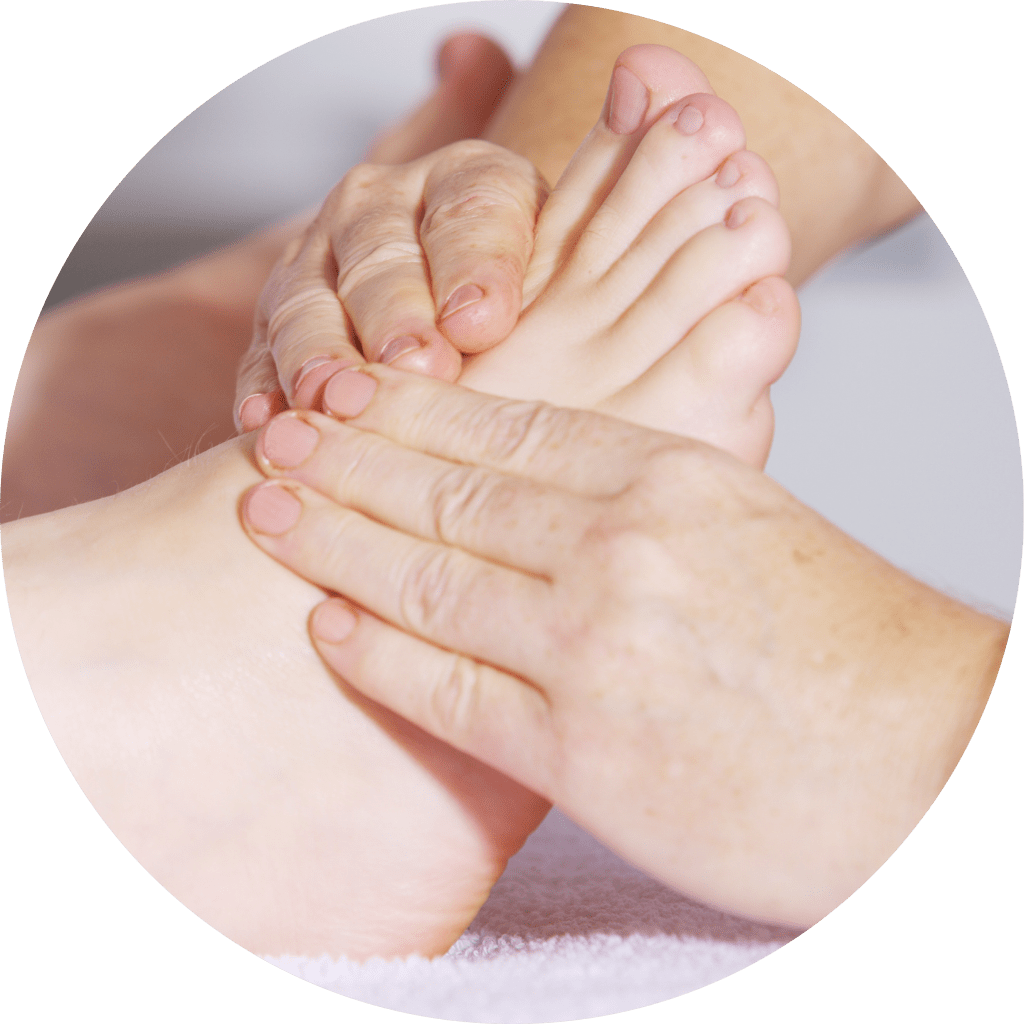
Whilst the art of reflexology dates back to Ancient Egypt, India and China, it wasn’t until 1913 that Dr William Fitzgerald introduced this therapy to the West as ‘zone therapy’. He noted that reflex areas on the feet and hands were linked to other areas and organs of the body within the same zone.
In the 1930’s Eunice Ingham further developed this zone theory into what is now known as reflexology. She observed that congestion or tension in any part of the foot is mirrored in the corresponding part of the body.
Reflexology is a complementary therapy, which works on the feet to help heal the whole person not just the prevailing symptoms.
How can Reflexology help me?
Reflexology can be used to help restore and maintain the body’s natural equilibrium. This gentle therapy encourages the body to work naturally to restore its own healthy balance.
Reflexology may help to ease the symptoms of
- Back pain
- Migraine
- Reproductive disorders
- Arthritis/ Rheumatism
- Sleep disorders
- Sports injuries
- Hormonal imbalances
- Digestive disorders
- Stress related conditions
The benefits of Reflexology
Reflexology is suitable for all ages and may bring relief from a wide range of acute and chronic conditions. After having completed a course of reflexology treatment for a specific condition, many people find it beneficial to continue with regular treatments in order to maintain health and well-being.
While many people use reflexology as a way of relaxing the mind and body and counteracting stress, at the same time many doctors, consultants and other health care professionals recognise reflexology as a well established, respected and effective therapy.
With ever increasing levels of stress, it is important people take more responsibility for their own health care needs.Reflexology helps us to cope on a physical, mental and emotional level thereby encouraging us to heal and maintain health in all areas of our lives.
Reflexology helps us to cope on a physical, mental and emotional level thereby encouraging us to heal and maintain health in all areas of our lives.
What happens during treatment?
On the first visit, I will have a preliminary talk with you to determine your present and past health and lifestyle.
I will then use my hands to apply pressure to the feet or hands. The application and the effect of the therapy are unique to each person.
A professionally trained reflexologist can detect subtle changes in specific points on the hands/feet, and by working on these points may affect the corresponding organ or system of the body.
A treatment session usually lasts for about one hour. A course of treatment may be recommended depending on your body’s needs.
vertical Reflex Therapy (VRT)
For certian mobility issues or musculo-skeletal conditions, vertical reflex therapy is recommended. The client stands for most of the treatment which magnifies the effect of mobilisation.
I was 3 weeks overdue and delivered my son that night, she didn’t promise anything but spoke a lot of sense too!
Janey P
 Barbara Firman Reflexology